Global web icon
britishcouncil.org
https://learnenglish.britishcouncil.org/grammar/en…
Modal verbs - LearnEnglish
We use modals to show if we believe something is certain, possible or impossible: My keys must be in the car. It might rain tomorrow. That can't be Peter's coat. It's too small. We also use them to do things like talk about ability, ask permission, and make requests and offers: I can't swim. May I ask a question? Could I have some tea, please?
Global web icon
7esl.com
https://7esl.com/modal-verbs/
Modal Verbs: A Complete Grammar Guide about Modal Verb - 7ESL
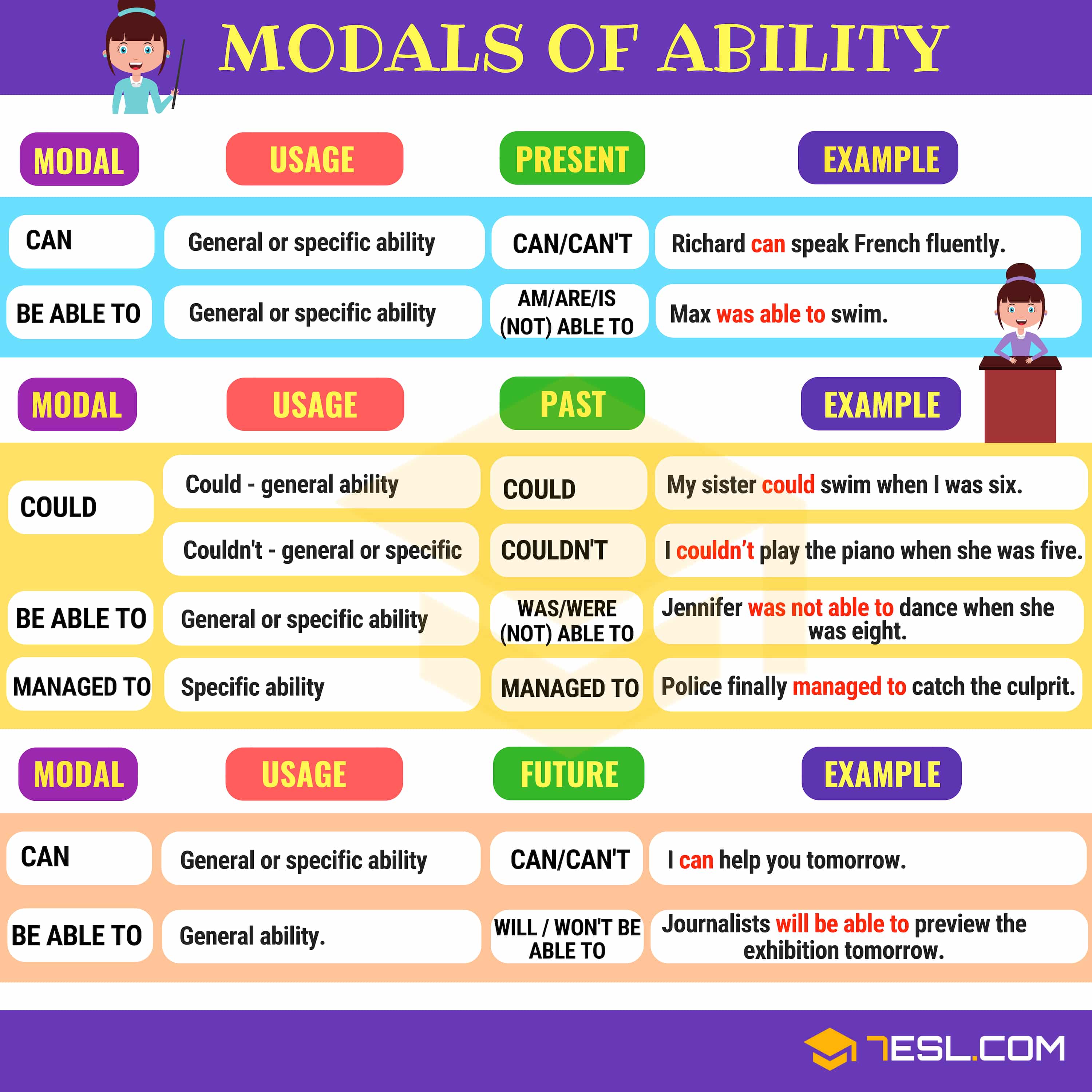
Modals of Ability – Created by 7ESL Modal Verbs Rules When using modal verbs, it’s important to follow certain rules to ensure your sentences are grammatically correct. One key rule is that the word “to” should not follow a modal verb. Here are some examples showing how different modal verbs are used: Will Promise: Don’t worry, I will ...
Global web icon
grammarly.com
https://www.grammarly.com/blog/parts-of-speech/mod…
What Are Modal Verbs? Definition and Examples - Grammarly
Modal verbs are auxiliary verbs like can, should, and must that express conditions such as possibility, ability, necessity, and permission. Frequently used modal verbs include…
Global web icon
eslforums.com
https://eslforums.com/modal-verbs-in-english/
Modal Verbs in English: Usage & Examples - ESL Forums
Unlike regular verbs, modals attach to the infinitive of another verb without the ‘to’—offering a specific tone or “mood” to the main verb in the sentence.
Global web icon
myenglishpages.com
https://www.myenglishpages.com/grammar-lesson-moda…
Modals: Meaning Of Modal Verbs, Usage, And Examples (A Comprehensive Guide)
Modal verbs, also known as modal auxiliary verbs or just modals, defy the conventional patterns of regular verbs. It works with main verbs to convey a rich array of meanings.
Global web icon
perfect-english-grammar.com
https://www.perfect-english-grammar.com/modal-verb…
MODAL VERBS - Perfect English Grammar
Here's a list of the modal verbs in English: can could may might will would must shall should ought to Modals are different from normal verbs: 1: They don't use an 's' for the third person singular. 2: They make questions by inversion ('she can go' becomes 'can she go?'). 3: They are followed directly by the infinitive of another verb (without ...
Global web icon
grammarist.com
https://grammarist.com/grammar/modal-verbs/
Modal Verbs - Uses, Examples - GRAMMARIST
You can use modals in the future and present time, showing different verb tenses to express hypotheticals and general events. But remember that not all modals can refer to a past situation.
Global web icon
grammareer.com
https://www.grammareer.com/modal-verbs/
Modal Verbs: Definition & Examples - Grammareer
Some modals like must and should remain unchanged, while can changes to could, and will changes to would when reported. Examples of Modal Verbs in Sentences Can: Maryam can bake delicious cakes. Hamza can help you with your homework. Could: Usman could jump very high when he was younger. Sara could come if she finishes her tasks early. May:
Global web icon
englishpage.com
https://www.englishpage.com/modals/modalintro.html
Modal Verbs | ENGLISH PAGE
Modals are special verbs, such as can or must, which behave very irregularly in English. Englishpage.com's in-depth modal tutorial will help you learn what makes modal verbs special. Study the modal descriptions and complete the exercises to take another step towards English fluency.
Global web icon
englishclub.com
https://www.englishclub.com/grammar/verbs-modals.p…
Modal Verbs | Learn English
Modals: CAN/COULD, WILL/WOULD, SHALL/SHOULD, MAY, MIGHT; MUST, OUGHT (TO). Modal verbs are auxiliary verbs (also known as 'helping verbs'). Normally modal verbs cannot work alone and must work with a main verb...